Someone picks up your hoodie at a pop-up. They don’t read the hangtag. They don’t check the GSM. They just touch it — and in that half-second, they’ve already decided what it’s worth and whether your brand deserves their attention.
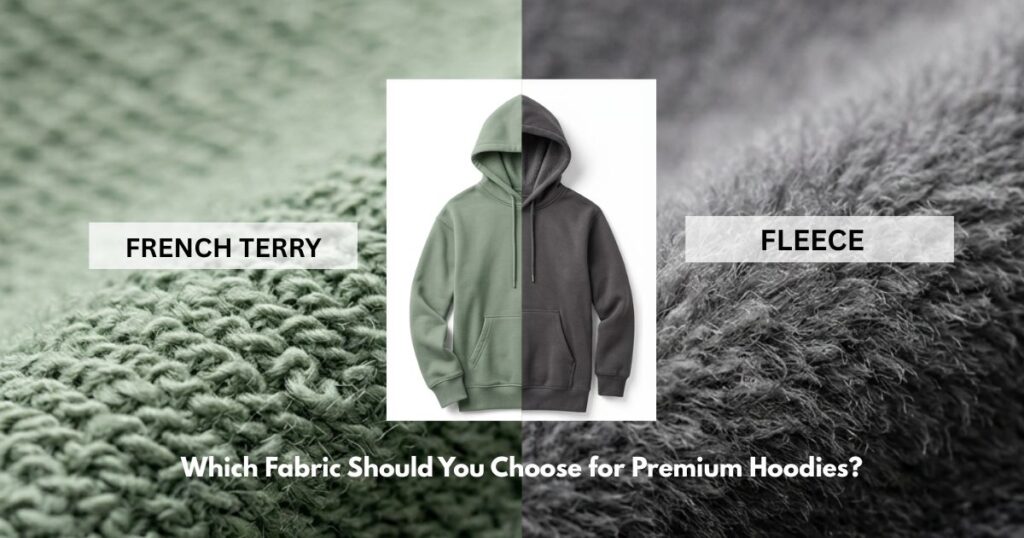
That moment isn’t decided at the point of sale. It’s decided six months earlier, in a sourcing conversation that most brands treat as an afterthought. French Terry or Fleece? It sounds like a technical footnote. It’s actually the founding decision of your entire product’s perceived value.
This guide is for sourcing agents and menswear founders who want a straight answer — no filler, no vague “it depends.” We’ll map both fabrics across GSM, structure, blend, climate, and brand positioning so you walk into your next factory conversation knowing exactly what to spec.
Understanding the Two Fabrics
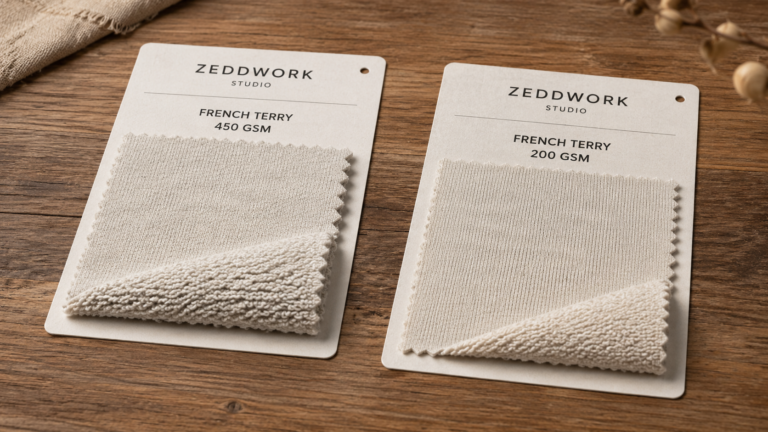
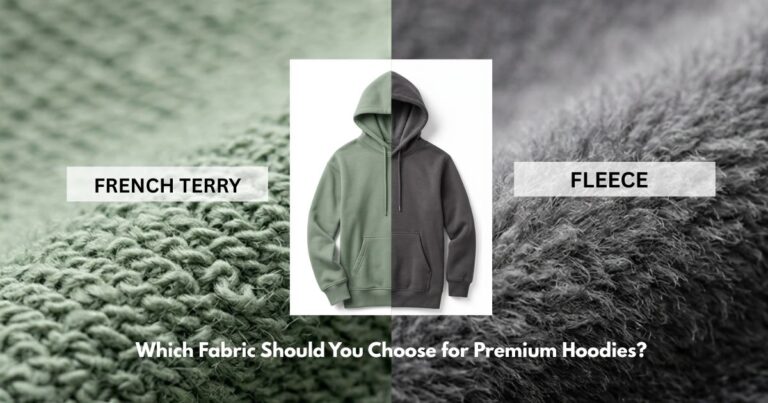
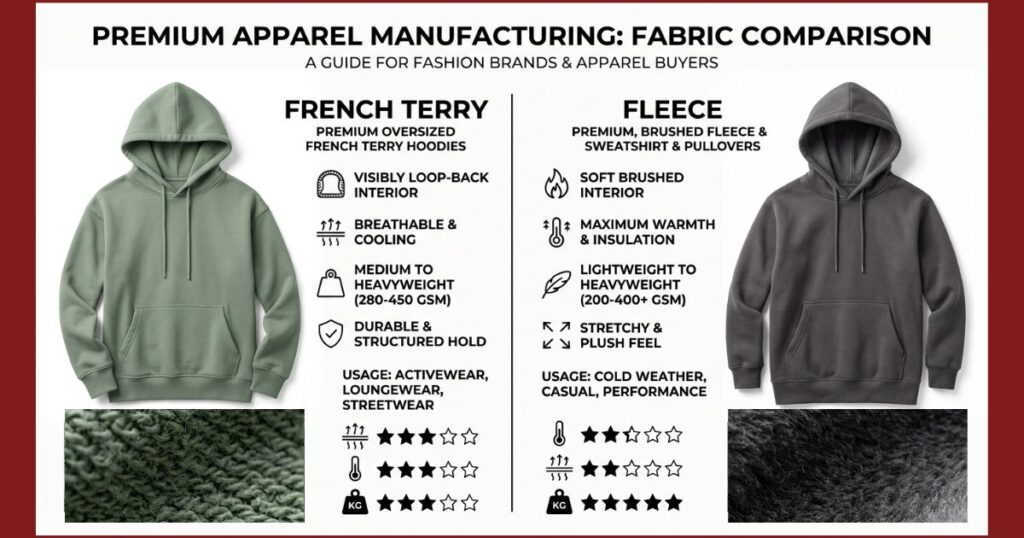
Both French Terry and Fleece are knitted loop fabrics — but their loop construction, weight, and hand feel diverge significantly. Understanding the structure is non-negotiable for any sourcing brief.
| French Terry | Fleece (Brushed) |
|---|---|
| Smooth flat face, uncut loops on the reverse | Smooth face, brushed/napped interior for softness |
| Knit structure: single-jersey base with looped back | Heavier, more insulating, warmer hand feel |
| Loops left uncut — retains moisture-wicking properties | Classic sweatshirt texture — skews more casual |
| Lighter, drapier, less bulk | Loops are cut then brushed — creates a soft pile |
| Breathable — suited for layering and mild climates | Ideal for colder climates and heavyweight drops |
| Higher perceived refinement at equivalent GSM | More forgiving in lower-cost productions |
Knit type breakdown
| Property | French Terry | Fleece (Brushed) |
|---|---|---|
| Base Knit | Jersey (flat) + loop back | Jersey + brushed loop pile |
| Interior Surface | Uncut loops — slightly textured | Cut & brushed — velvety soft |
| Breathability | High — open loop structure | Medium — pile traps air |
| Warmth | Moderate (mild to warm climates) | High (cool to cold climates) |
| Drape | Fluid, structured | Boxy, relaxed |
| Pilling Risk | Lower (loops intact) | Higher (cut pile frays) |
| Print Clarity | Excellent (smooth face) | Good (slight texture) |
| Premium Appeal | Higher at same GSM | Requires heavier GSM to signal premium |
GSM guide — what weight for your product?
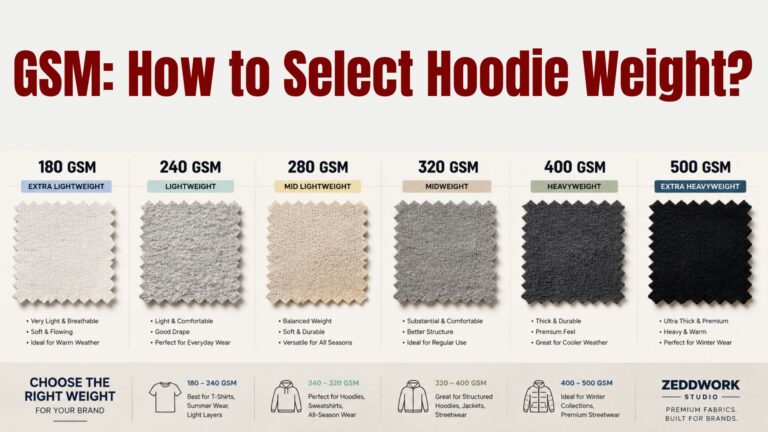
GSM (grams per square metre) is the single most misunderstood spec in knitwear sourcing. Brands chase high GSM numbers without understanding that the same weight in French Terry vs. Fleece delivers a completely different experience. Here’s how to read it correctly:
- French Terry — Lightweight (180–220 GSM) – Spring/ Summer hoodies, resort, layering
- French Terry — Mid-weight (240–280 GSM) – Year-round, premium everyday sweatshirts
- French Terry — Heavyweight (300–360 GSM) – Premium streetwear, structured crewnecks
- Fleece — Standard (260–320 GSM) – Mid-range hoodies, fast fashion tier
- Fleece — Premium (340–400 GSM) – Heavyweight drops, winter hoodies
- Fleece — Ultra-heavy (420–500 GSM) – Luxury loungewear, workwear-inspired drops
Key principle: a 280 GSM French Terry reads more refined than 280 GSM Fleece — the smooth outer face and intact loop structure signals intention. If you’re committed to Fleece at a premium positioning, go no lighter than 360 GSM. Anything below that reads as commodity, regardless of label.
The most popular fabric blends — and what they actually mean
The cotton-polyester ratio shapes everything from shrinkage to colour retention to the brand story you’re entitled to tell. Here are the blends that matter for hoodies and sweatshirts.
CLASSIC BLEND
80/20
Cotton / Polyester. The industry standard. Soft, breathable, good structure. Slight shrinkage risk. Ideal for most mid-market brands entering a new category.
PERFORMANCE EVERYDAY
60/40
Cotton / Polyester. More durable, better colour retention, minimal shrinkage. Slightly less natural hand feel. Strong choice for athletic-adjacent or activewear-crossover brands.
PREMIUM
100% Cotton
Ringspun or combed. Maximum breathability and storytelling legitimacy. Higher shrinkage risk — spec 10% oversized. Best reserved for brands with a clear natural-material narrative.
LUXURY PERFORMANCE
Cotton + Modal
Usually 70/30 or 60/40. Modal adds exceptional drape and silkiness. Ideal for slim-fit pullovers and elevated basics at the top end of the market.
Country, climate, and fabric logic
Climate isn’t just a weather question — it’s a wearability and seasonality question. A 420 GSM fleece hoodie is a commercial mistake in Singapore. A 200 GSM French Terry is dead stock in Oslo in November.
🌡
Tropical / Hot humid
India, SE Asia, UAE, Brazil
Lightweight French Terry
Light cotton or cotton-modal. AC-culture makes this viable year-round indoors.
🍂
Temperate / Four-season
UK, US, EU, Japan, Korea
Mid-weight French Terry or premium Fleece
Season-split drops work well. Fabric tier determines drop positioning.
❄️
Cold / Nordic
Scandinavia, Canada, Northern EU
Heavyweight Fleece
Bulk is expected. Fleece-lined or double-face constructions perform best.
🌤
Mediterranean / Mild
Spain, Italy, Australia, California
Mid-weight French Terry
Year-round viability. The elevated basics category thrives in this climate.
🏙
Urban / AC-dominant
Gulf, Singapore, NYC summers
Lightweight to mid French Terry
Indoor lifestyles make lighter weights commercially option.
🌏
Global / DTC export
Multi-market drops
Mid-weight French Terry
The safest universal weight. Positions as year-round for all.
What actually makes a hoodie premium?
Premium isn’t one thing — it’s the compounding of a dozen decisions your customer can’t name but absolutely feels. Here’s what moves the needle when you’re trying to price above the noise.
Fabric hand feel — weight, softness, and drape. The first touch sets the entire perception.
Garment wash — stone-wash, enzyme wash, or pigment dye. Removes that stiff “new fabric” feel.
Rib quality — cuffs and hem ribs should be 1×1 or 2×1 rib, not waffle or loose knit.
Seam construction — flatlock, chain stitch, or coverstitch at stress points. No raw surging on visible seams.
Hood structure — two-panel vs. one-panel shape. Two-panel sits and drapes better when worn down.
Kangaroo pocket weight — pocket should hang flush, not gap. Requires pocket lining or heavier base fabric.
Drawcord — flat woven cord with metal or resin tips. Round cord with plastic tips immediately reads cheap.
Labelling — woven label, not printed. Twill tape neck label. Heat-transfer labels undercut premium positioning.
The decision matrix
| Your Position | Go French Terry | Go Fleece |
|---|---|---|
| Brand positioning | Premium, refined, elevated basics | Streetwear, athletic, heritage |
| Climate | Mild, tropical, temperate spring/summer | Cold, four-season autumn/winter |
| Key garment type | Crewneck, pullover, slim hoodie | Heavyweight hoodie, zip-up, coach jacket |
| Print or embroidery? | Print: excellent. Embroidery: great | Embroidery: excellent. Print: good |
| Customer expectation | Drape, softness, breathability | Warmth, bulk, cosy weight |
| MOQ sensitivity | Works at lower MOQ per colourway | Needs higher MOQ for consistent brushing |
| Garment wash viability | Excellent — washes beautifully | Good — but pilling risk increases |
| Market tier | Considered to luxury | Entry to considered |