From GSM selection and fabric construction to garment dyeing, embroidery, and finding the right global manufacturing partner — everything American brands need to build a hoodie line that commands a premium price.
Why Hoodies Are the Centerpiece of Modern American Streetwear
No garment in contemporary fashion has traversed the journey from sportswear to luxury quite like the hoodie. In 2025, American consumers spend over $10 billion annually on premium hoodies — and the market is still growing.
From ultra-luxury brands like Fear of God and Aimé Leon Dore commanding $400+ price points, to emerging DTC labels discovering that a well-crafted hoodie can anchor an entire brand identity, the category has never been more competitive — or more lucrative. But with opportunity comes complexity. Not every hoodie is created equal, and the gap between a $25 blank and a $250 premium piece is far more than a label or margin.
That gap lives in construction decisions made months before a garment reaches the consumer: in the weight and composition of the fabric, the way yarn is spun, how the dye settles into the fiber, the density of stitches in an embroidered chest logo, and the particular softness that comes only from a proper garment wash. This guide unpacks each of those decisions — so that whether you’re launching a new label or scaling an established brand, you can build hoodies that earn their price.
A premium hoodie isn’t a product. It’s a sequence of a hundred right decisions that the customer feels before they even consciously notice
What Actually Makes a Hoodie Premium?
Premium is not a price point. It is a convergence of material quality, construction integrity, fit precision, and sensory experience — and all of it is detectable to a customer the moment they touch the garment.
Fabric Composition & Yarn Quality
The fiber blend determines the character of the garment. A true premium hoodie almost always starts with 100% ring-spun cotton or a high-quality ring-spun cotton/polyester blend (typically 80/20 or 60/40). Ring-spun yarns are produced by continuously twisting and thinning cotton fibers into a rope-like strand, making them stronger, softer, and more durable than open-end or air-jet spun alternatives. Combed and ring-spun cotton — where the shorter fibers are combed out before spinning — is the gold standard for luxuriously soft, pill-resistant fabric.
Beyond cotton blends, premium positioning increasingly involves specialty fibers: French terry for breathable athleticwear hoodies, heavyweight brushed fleece for streetwear and winter drops, Supima cotton for exceptional softness, or organic cotton certifications (GOTS, OCS) for brands playing in the sustainability space. Each fiber choice communicates something to the consumer — and each demands different manufacturing expertise.
Construction Details That Signal Quality
Premium hoodies are recognized before they’re worn. Look-of-quality signals include: a structured hood with a two-piece construction (not a simple folded-over flap), ribbed cuffs and hem with enough stretch recovery to hold their shape after hundreds of wears, flat-lock or clean-finish internal seaming, and a kangaroo pocket that lies flat against the body without puckering. The drawcord should be flat-woven, not round, and should include reinforced metal or resin eyelets. Zipper hardware on full-zip styles — whether YKK or Riri — is another instant signal.
Weight, Structure & Drape
How a hoodie falls on the body is as important as what it’s made of. The right GSM for the intended end-use, combined with proper pre-shrinking and stabilization, determines whether the garment drapes fluidly, holds a relaxed boxy silhouette, or sits close and structured. Premium brands often invest in custom fabric development — proprietary loops, yarn ratios, and knit structures that create a signature hand-feel unavailable off-the-shelf.
Finishing & Wash
A hoodie that comes off the production line is rarely the same hoodie the consumer receives. Premium finishing — enzyme washing, garment dyeing, stone washing, silicon softening, or specific steam and pressing treatments — transforms a well-made piece into something that feels lived-in, broken-in, and irreplaceable from the first wear.
Choosing the Right GSM for Your Hoodie
GSM — grams per square meter — is the single most misunderstood specification in hoodie manufacturing. It determines weight, warmth, structure, cost, and the entire sensory experience of the garment.
There’s no universally “correct” GSM. The right choice depends on your brand positioning, the intended use case, your target retail price, and the climate preferences of your customer base. Here’s a comprehensive breakdown
| GSM RANGE | CATEGORY | CHARACTERISTICS | BEST FOR | RETAIL POSITION |
|---|---|---|---|---|
| 180 – 240 GSM | Lightweight | Thin, drapey, breathable. Softer structure, great printability. | Warm-weather markets, spring drops, lightweight layering, activewear | $ |
| 260 – 300 GSM | Midweight | The sweet spot for most DTC brands. Holds shape, good body, year-round wearability. | Everyday premium wear, brand basics, collegiate aesthetics | $$ |
| 320 – 400 GSM | Heavyweight | Substantial hand-feel, structured silhouette, excellent garment-dye response. | Streetwear, luxury basics, fall/winter drops, drop culture releases | $$$ |
| 400 – 400 GSM | Ultraheavy weight | Blanket-like weight. Dramatic drape. Statement piece. Niche market but very high perceived value. | Luxury collaborations, limited-edition drops, cold-climate markets | $$$$ |
GSM and Garment Dyeing
If garment dyeing is part of your value-add strategy — and it absolutely should be considered — GSM becomes critical. Lower GSM fabrics absorb dye differently, often producing lighter, more washed-out results. Heavyweight fabrics (320 GSM and above) take garment dye dramatically, producing rich, uneven, vintage-looking color that cannot be achieved through yarn-dyed or fabric-dyed processes. If the look you’re after is that slightly uneven, worn, deeply saturated color characteristic of premium streetwear brands, plan your GSM selection accordingly.
GSM and Shrinkage Management
Higher GSM fabrics shrink more dramatically if not pre-treated. A 400 GSM hoodie that hasn’t been properly pre-shrunk can lose 8–12% in length after the first wash, which is catastrophic at the retail level. Premium manufacturers pre-shrink fabric at the mill stage, then conduct post-production wash tests on finished garments. Always request a wash test from any manufacturer before approving bulk production.
What Type of Hoodie Do You Want to Manufacture?
Before finalizing any production specification, every brand must clearly define the category of hoodie they are making. Each type carries distinct construction requirements, hardware, fabric choices, and margin structures.
Value Addition: How to Make Your Hoodie Truly Stand Out
In a saturated market, a great fabric and a clean silhouette are table stakes. The brands commanding $200+ for a hoodie are winning on value addition — the craft, the process, and the details that transform a well-made blank into an object of desire.
The most compelling premium hoodies in the market today layer multiple value-addition techniques: a garment-dyed body with tonal puff print branding, interior kantha stitching detail, enzyme washed for softness, with a hand-distressed finish. Each technique adds cost — but far less cost than the price premium it enables in the market.
Why India Is the Ideal Manufacturing Partner for USA Hoodie Brands
In a world of shifting supply chains, rising costs in China, and growing concerns about transparency and ethics, India has emerged as the most strategically advantageous manufacturing partner for American apparel brands — particularly in the premium and mid-to-luxury segment.
Zeddwork Studio: Where Premium Hoodies Are Born
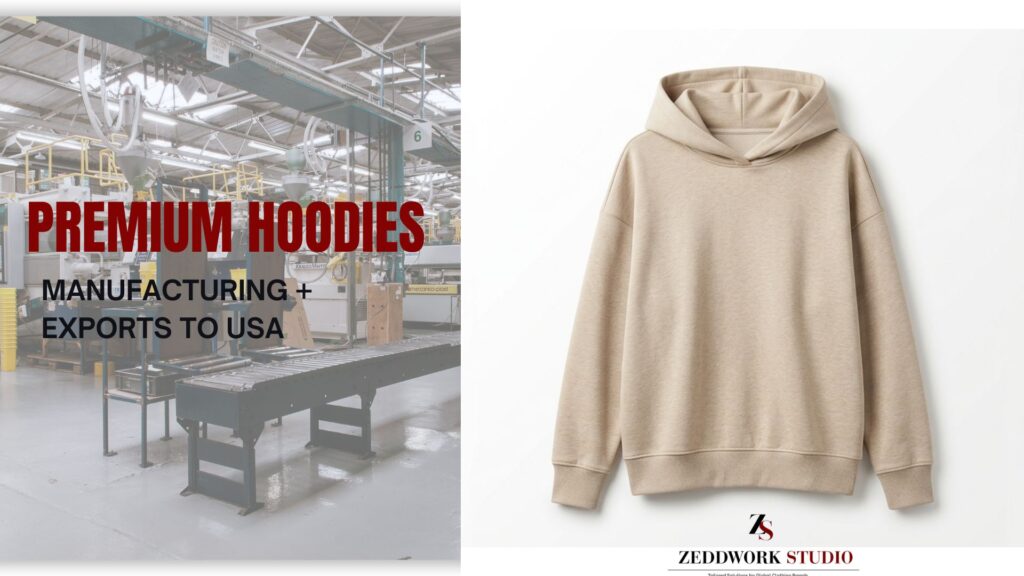
If you’ve read this far, you understand that making a truly premium hoodie demands more than a factory — it demands a partner with deep material knowledge, artisanal craft heritage, technical precision, and an understanding of what the American premium market requires. That partner is Zeddwork Studio.
Based in New Delhi, India — the heart of India’s premium textile and craft manufacturing ecosystem — Zeddwork Studio is a specialized garment manufacturing and export house built specifically for American and European brands that refuse to compromise on quality. We are not a bulk commodity manufacturer. We are a craft-first studio that happens to have the infrastructure to scale.
What We Do
- Custom Hoodie Manufacturing
- GSM Consultation & Fabric Sourcing
- Garment Dyeing
- Enzyme & Stone Washing
- Custom Color Development
- High-Density Embroidery
- 3D Puff Embroidery
- Screen Printing (Water-Based)
- Discharge Printing
- Tonal Printing
- Handwork & Artisanal Detailing
- Custom Labels & Trims
- Small-Batch Sampling
- Sustainable / GOTS Manufacturing
- USA Export & Logistics