Ask any experienced merchandiser what separates a hoodie that sells at $35 from one that sells at $150, and the answer rarely starts with the design. It starts with the fabric. Silhouette and branding matter, but fabric is what a customer actually feels in the first three seconds of trying something on — and it’s what determines whether that hoodie still looks and feels premium after thirty washes.
If you’re specifying fabric for a 2026 hoodie collection, here’s everything you need to know to make that decision with confidence: the core fabric types, the GSM ranges that actually matter, the sustainable options gaining real traction, and how to match all of it to your price point and customer.
1. GSM: The Number That Decides Everything
GSM (grams per square meter) is the single most important spec on your tech pack. It determines weight, warmth, drape, durability, and — more than almost any other factor — how “expensive” a hoodie feels in hand.
Here’s the range breakdown clothing brands are working with in 2026:
| GSM Range | Category | Best For |
|---|---|---|
| 200–280 GSM | Lightweight | Layering pieces, warm-climate hoodies, promotional/merch |
| 280–320 GSM | Mid-weight | Everyday hoodies, transitional-season staples |
| 320–380 GSM | Premium standard | Streetwear, lifestyle brands, most premium DTC labels |
| 380–450 GSM | Heavyweight | Fashion-forward streetwear, structured oversized fits |
| 450–550 GSM | Ultra-heavyweight | Flagship “hero” pieces, luxury drops, hooded jackets |
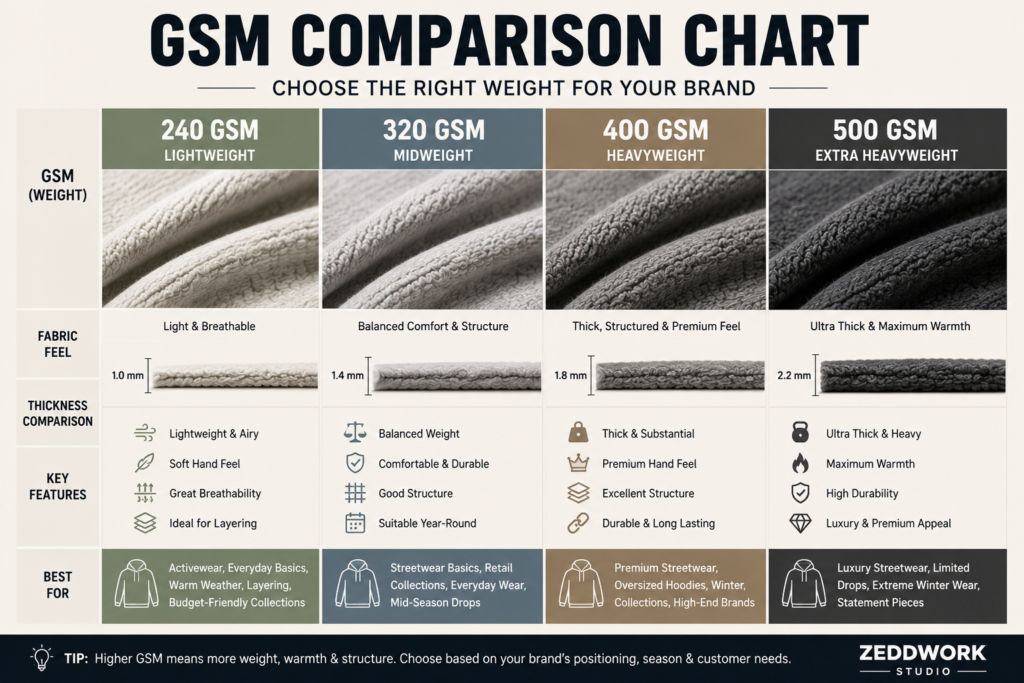
A useful rule of thumb: below 300 GSM, you’re firmly in t-shirt-with-a-hood territory. Above 450 GSM, you’re approaching jacket weight. Most premium hoodie programs — the ones retailing between $80 and $200 — land in the 320–450 GSM window, because that’s where the fabric feels genuinely substantial without becoming stiff or impractical to wear indoors.
One frequently overlooked detail: cotton shrinks. Untreated cotton fleece or French terry can shrink 5–8% after the first wash if it isn’t pre-shrunk (sanforized) before cutting. Always request a washed sample before committing to a bulk run — sizing complaints after launch are one of the most common (and avoidable) failures in hoodie production.
2. The Core Fabric Types, Compared
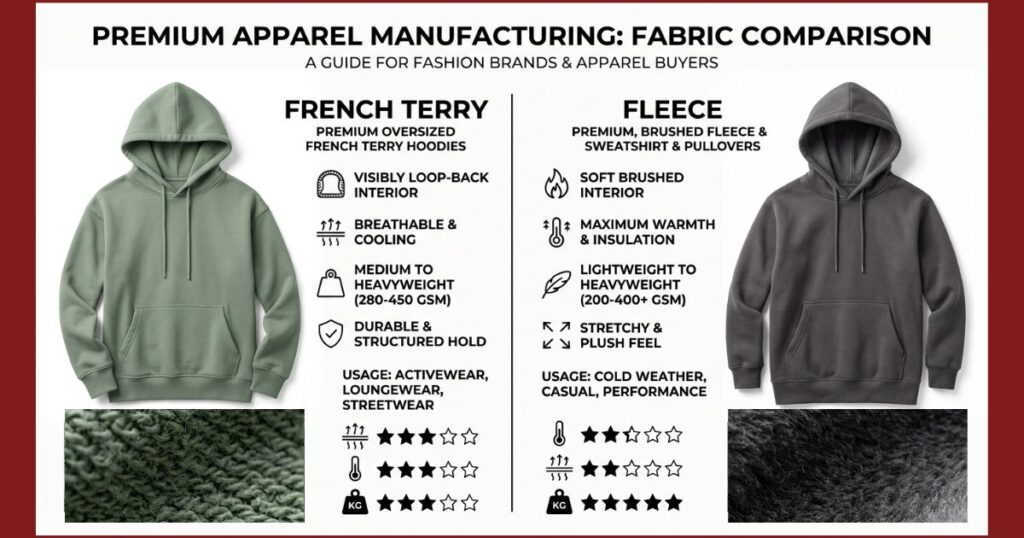
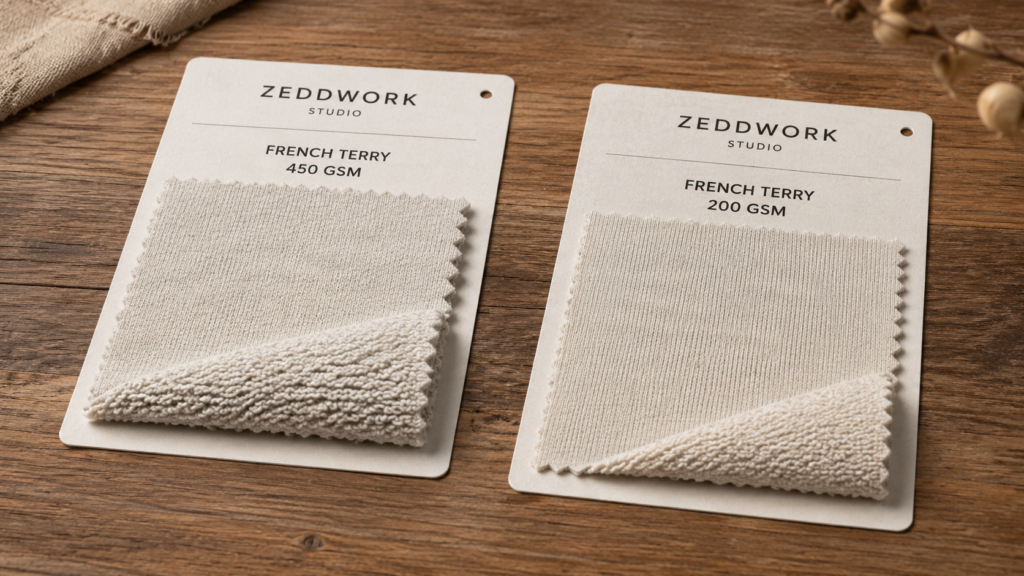
French Terry
A looped-knit fabric — smooth on the face, uncut loops on the interior (as opposed to fleece’s brushed finish). This is the fabric of choice for brands that want their hoodie to feel elevated without feeling heavy.
- Typical GSM: 240–380
- Strengths: Breathable, drapes beautifully in oversized cuts, doesn’t trap heat, photographs cleanly for e-commerce
- Weaknesses: Holds screen print and embroidery slightly less crisply than brushed fleece at equivalent GSM
- Best for: Minimalist, logo-light designs where hand-feel does the talking; warmer-climate collections; brands whose customers wear hoodies as daily layering pieces rather than pure cold-weather gear
Cotton Fleece (Brushed Fleece)
The fabric most people picture when they think “hoodie” — knit on the face, brushed on the interior to raise a soft, insulating nap.
- Typical GSM: 280–450+
- Strengths: That signature plush, cozy interior; holds heavy embroidery, puff print, and bold chest graphics cleanly; ages well, often softening further with wash
- Weaknesses: Heavier and warmer, which can be a liability in warm-climate markets
- Best for: Streetwear brands leaning into logo or graphic-driven design; cold-weather collections; brands positioning around a “cult classic” heavyweight hoodie (think Champion Reverse Weave-style positioning at ~400 GSM)
Cotton-Polyester Blends (80/20, 60/40)
Blending in polyester trades a small amount of natural hand-feel for meaningfully better shape retention and lower shrinkage.
- Typical composition: 80% cotton / 20% polyester is the most commonly ordered blend across the industry; 60/40 blends push durability and cost-efficiency further
- Strengths: Reduced shrinkage, better recovery after stretching, generally lower cost than 100% cotton at equivalent GSM
- Weaknesses: Slightly less breathable and less “natural” feeling than pure cotton; harder to market authentically to sustainability-focused customers
- Best for: Brands prioritizing consistent fit and lower return rates over a premium natural hand-feel claim; large-scale production where cost efficiency matters
Organic Cotton Fleece / French Terry
Functionally similar in construction to standard cotton versions, but grown without synthetic pesticides and, when GOTS-certified, tracked through a verified supply chain.
- Typical GSM: 280–380
- Price premium: Roughly 20–40% above standard cotton at the same weight
- Strengths: Genuine sustainability story, softer growing profile, strong resonance with environmentally conscious customers
- Consideration: GOTS certification requires confirming your mill sources certified fiber all the way through — verify this at the enquiry stage rather than assuming a factory’s “organic cotton” claim is certified
3. The Sustainable Fabrics Actually Gaining Traction in 2026
Sustainability claims are easy to make and hard to substantiate — but a handful of materials have moved well past greenwashing territory and into genuine mainstream adoption for premium hoodies:
Tencel (Lyocell) — Made from wood pulp through a closed-loop process that recovers the vast majority of water and solvents used. Tencel brings a silky, fluid hand-feel and excellent moisture management, and drapes exceptionally well in French terry construction, typically in the 280–340 GSM range. It’s become a favorite for fashion-forward and transitional-season hoodies where drape matters as much as warmth.
Recycled Polyester (rPET) Blends — Made from recycled plastic (commonly post-consumer bottles) blended with organic cotton. These hybrid fabrics have become something of a sweet spot for 2026 collections: the cotton delivers the soft hand-feel customers expect, while the rPET component improves pilling resistance, shape retention, and durability — often performing especially well at heavier 340–400 GSM weights for premium heavyweight drops.
Hemp Blends — Hemp requires a fraction of the water cotton does, needs no pesticides, and actively improves soil health where it’s grown — one of the strongest sustainability stories of any natural fiber. The tradeoff is that raw hemp fiber can be stiff, requiring skilled knitting and finishing to achieve a soft hand-feel; the mills that have solved this well are producing genuinely competitive streetwear-grade fabric.
Modal — A beechwood-derived cellulosic fiber offering a soft, drapey feel in lighter French terry or jersey-adjacent hoodie constructions, often blended with cotton to maintain structure.
If sustainability is core to your brand story, treat certification the way you’d treat a fit spec: get it in writing, ask for the certificate, and don’t rely on a factory’s marketing language alone.
4. Matching Fabric to Decoration Method
Fabric choice isn’t just about feel — it directly affects how your branding looks on the finished garment.
- Bold chest logos, puff print, or heavy embroidery → Cotton fleece’s brushed surface and denser structure hold these decoration methods more cleanly, with less puckering, than lighter French terry.
- Minimalist branding, small embroidered marks, or tonal design → French terry’s smoother face gives cleaner, more even results for screen print and DTG, and lets the fabric’s own texture carry the design story.
- Heavyweight fabrics generally (380+ GSM) → Provide a more stable canvas for stitching in general, reducing puckering around embroidered logos regardless of fleece vs. terry.
Decide your decoration approach before you lock your fabric spec — retrofitting a design onto the wrong base fabric is one of the most common (and costly) mid-production corrections.
5. Matching Fabric to Climate and Season
- Warm climates / year-round wear: French terry at 280–320 GSM. Lighter, breathable, and doesn’t trap heat during air-conditioned indoor wear or mild outdoor temperatures.
- Transitional seasons (spring/fall): French terry at 300–360 GSM, or a lighter cotton fleece in the same range.
- Cold weather/winter flagship pieces: Fleece at 380–450+ GSM. This is where customers expect — and feel — genuine warmth, and it’s the weight range that supports a hoodie’s positioning as a true outerwear alternative.
- Oversized, boxy silhouettes: French terry generally drapes better in oversized cuts without adding bulk; very heavy fleece in an oversized fit can start to feel overwhelming rather than architectural.
6. Construction Details That Separate Premium From Basic
Fabric selection only gets you halfway there. The construction choices layered on top of the base fabric are what actually read as “premium” to a customer:
- Matching ribbing for cuffs, waistband, and neckline, dyed in the same lot as the body fabric — mismatched ribbing is one of the fastest ways a hoodie reads as unfinished.
- Double-needle or flatlock stitching at stress points (shoulder seams, side seams) for durability and a cleaner interior finish.
- Pre-shrunk (sanforized) fabric, confirmed with a washed sample before bulk production.
- Weight-appropriate hardware — metal aglets, quality drawcords, and zippers (where applicable) that match the fabric’s overall positioning; cheap trims undercut an otherwise excellent fabric choice instantly.
- Garment-dyeing where appropriate for a richer, slightly irregular tonal finish that many premium labels use to signal a more considered, less mass-produced product.
7. A Practical Fabric-Selection Framework
Before you brief your factory, answer these four questions in order:
- What’s my price point? Fabric typically represents 40–55% of total hoodie manufacturing cost, and GSM drives that cost directly — heavier fabric means more material by weight per unit. Your retail price should inform your GSM target, not the other way around.
- What’s my customer’s climate and use case? Daily wear in a mild climate points to French terry; genuine cold-weather positioning points to heavier fleece.
- What’s my decoration strategy? Heavy graphics favor fleece; minimalist or tonal branding favors French terry.
- Does sustainability matter to my brand story? If yes, decide early whether you need organic cotton, recycled blends, Tencel, hemp, or full GOTS/GRS certification — this affects mill selection, MOQ, and cost from day one, not something to retrofit later.
Once you’ve answered these, request physical swatches — never commit to a fabric based on a spec sheet alone. GSM numbers can be technically accurate and still feel completely different in hand depending on yarn quality (ring-spun vs. carded, combed vs. standard) and finishing process.
The Bottom Line
There’s no single “best” fabric for a premium hoodie in 2026 — there’s a best fabric for your brand’s price point, climate, decoration method, and sustainability positioning. What’s changed is the range of genuinely good options available at scale: heavyweight French terry and fleece in the 320–450 GSM sweet spot remain the foundation of premium hoodie programs, while Tencel, recycled-poly/organic-cotton hybrids, and hemp blends have moved from niche to mainstream viable choices for brands that want a real sustainability story, not just a marketing line.
Whatever you choose, the fundamentals don’t change: swatch before you commit, wash-test before you cut, and match your ribbing, trims, and construction quality to the fabric weight you’ve chosen. That’s what turns a good fabric spec into a hoodie customers actually feel is worth the price tag.