If you’re a sourcing manager, store owner, or brand founder watching your category data, you’ve probably already noticed it: the hoodie stopped being an afterthought. It’s now a flagship product. Brands that once led with tailored jackets or statement outerwear are now opening their lookbooks with a $180–$400 hoodie — and it’s often the item that sells out first.
This isn’t a fluke of one season. It’s a structural shift in how consumers spend on apparel, and it has direct implications for who you choose to manufacture with. Let’s break down why this happened, what actually makes a hoodie “luxury,” and why India — has become the sourcing destination serious brands are quietly building long-term partnerships around.
1. The Numbers Behind the Trend
This isn’t just a vibe shift — it shows up clearly in the data.
- The global loungewear market, which includes premium hoodies and sweatshirts as a core category, is projected to grow at a compound annual rate of roughly 7–9% through the mid-2030s, with several forecasts placing the global market between $6 billion and $19 billion depending on scope and methodology.
- The luxury segment specifically is growing faster than the mid-market and economy tiers. Multiple industry reports peg the luxury loungewear and sleepwear category’s growth rate above 7.5% annually — outpacing the broader apparel market.
- More than half of loungewear production globally now happens in Asia-Pacific, reflecting how deeply intertwined premiumization has become with manufacturing efficiency — brands want elevated quality without elevated cost structures.
- Nearly two-thirds of apparel consumers now report owning multiple loungewear pieces, with average purchase frequency climbing year over year, a sign that “athleisure fatigue” hasn’t materialized — it’s evolved into something more considered.
The takeaway for anyone sourcing product: this is not a passing trend to chase for one collection. It’s a durable consumer shift, and the brands winning in it are the ones investing in reliable, quality-focused manufacturing relationships rather than one-off production runs.
2. Why the Hoodie, Specifically?
Plenty of garments could have absorbed the “comfort meets status” shift. The hoodie won for a few concrete reasons:
It’s the ultimate blank canvas for brand identity. Unlike a fitted shirt or tailored jacket, a hoodie’s silhouette is simple enough that fabric, weight, and construction do all the talking. That makes it the perfect vehicle for brands to communicate quality without needing complex design — which is exactly why the fabric and finishing decisions matter so much (more on that below).
Remote and hybrid work permanently changed the wardrobe hierarchy. When a huge share of the workday no longer requires formal dressing, comfort-first garments stopped being “downtime only” and became legitimate daywear — worn to the office, on flights, to dinner. That transition pulled loungewear out of the bedroom and into the same purchasing decisions as outerwear.
Athleisure matured into “elevated comfort.” The first wave of athleisure was about performance fabrics and gym-to-street versatility. The current wave is about craftsmanship — heavier French terry, garment-dyed finishes, reinforced ribbing, clean interior seams — the same details you’d expect from a $600 knit sweater, just applied to a hoodie.
Social proof accelerated it. Influencer and creator culture normalized “expensive basics” as a status signal that’s quieter than logos — a heavyweight, perfectly-fitted, beautifully finished hoodie now reads as more discerning than an obvious logo piece.
Sustainability and longevity concerns favor fewer, better pieces. Consumers buying into “luxury basics” are often explicitly rejecting fast fashion’s disposability. A well-made hoodie that lasts five years and looks better with age fits that mindset — which raises the bar for the manufacturing partner who has to actually deliver that durability at scale.
3. What Actually Makes a Hoodie “Luxury”?
This matters enormously for sourcing, because “luxury” isn’t a marketing word — it’s a spec sheet.
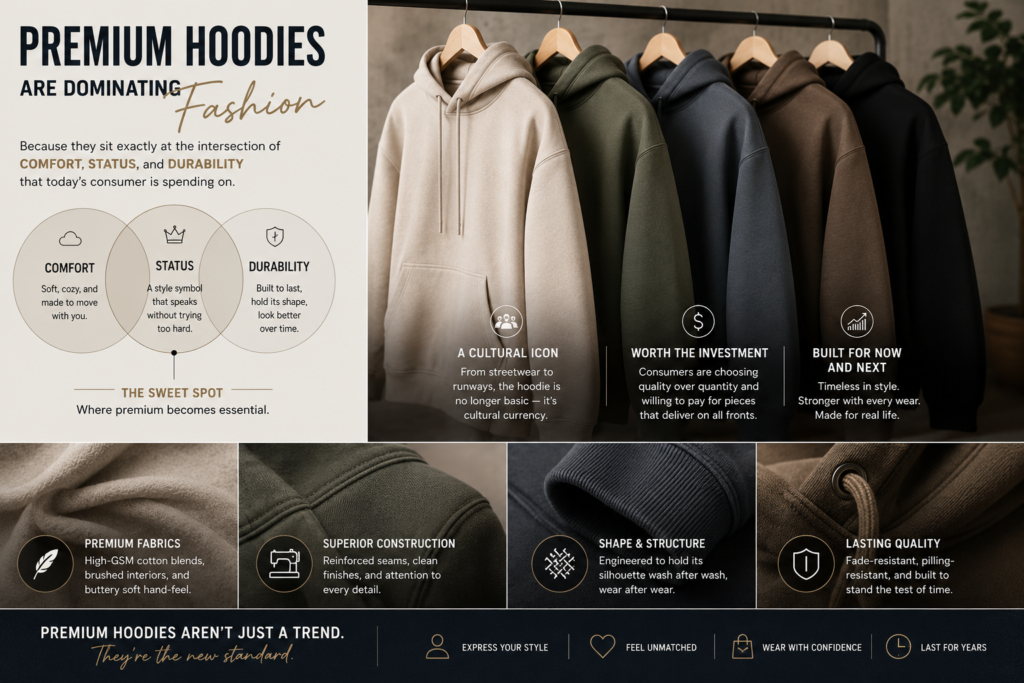
- Fabric weight and composition. Premium hoodies typically run 340–500 GSM in heavyweight French terry or brushed fleece, often blended with modal, Supima cotton, or Tencel for hand-feel and drape — not the 220 GSM single-jersey fleece common in fast fashion.
- Yarn quality. Combed, ring-spun, or compact-spun cotton yarns produce a smoother, more durable fabric than the carded yarns used in budget production.
- Garment dyeing vs. yarn dyeing. Many premium labels garment-dye finished pieces for a richer, slightly irregular tone that reads as considered rather than mass-produced.
- Construction details. Double-needle stitching, reinforced shoulder seams, ribbed cuffs with proper recovery, YKK or equivalent zippers, and clean interior finishing (no visible overlock fraying) are the difference consumers feel even if they can’t articulate why.
- Fit engineering. Luxury hoodies are pattern-engineered for a specific drape — oversized-but-structured, not just “big.” That requires a factory with genuine pattern-making expertise, not just cut-and-sew capacity.
- Trims and hardware. Custom drawcords, branded metal aglets, woven labels, and tonal thread matching are small costs that compound into a very different unboxing experience.
None of this is achievable with a factory that’s optimized purely for speed and rock-bottom pricing. It requires a manufacturing partner that treats fabric development and finishing as seriously as you treat your brand positioning.
Zeddwork Studio is a perfect manufacturing and export partner for your brand if you’re looking to develop a customized premium luxury hoodie with the right fabric blend and weight, offering different dyeing and finishes, and have deep expertise in fits and pattern making.
4. Why India Has Become the Go-To Sourcing Destination
For brands weighing China, Bangladesh, Vietnam, Turkey, and India against each other, here’s the honest picture that’s shaping decisions right now:
China has moved upmarket
Labor costs have risen substantially, and large Chinese factories increasingly carry minimum order quantities that are out of reach for growing or mid-sized brands. China still leads on certain technical categories, but for knitwear specifically, it’s no longer the default low-friction choice it once was.
Bangladesh is priced for volume, not for range
Bangladesh remains extremely competitive for very high-volume, simpler garments. But the ecosystem is less built out for the kind of smaller-batch, multi-spec, frequently-revised custom work that premium and growing brands typically need — you trade flexibility for price.
India occupies the sweet spot
India has built a genuinely rare combination: lower minimum order quantities than most large Chinese factories, more flexibility on custom specification than Bangladesh, and a fabric ecosystem broad enough to support everything from basic cotton fleece to Tencel and organic-blend premium knits, often within the same production cluster.
Some concrete reasons why manufacturing houses like Zeddwork Studio specifically stands out:
- It’s a fully vertically integrated cluster. Spinning, knitting, dyeing, printing, garmenting, and finishing all happen within one interconnected ecosystem — meaning fewer handoffs, tighter quality control, and faster turnaround than sourcing fabric and garmenting from separate countries.
- Export experience with Western markets. Zeddwork Studio has been exporting to the USA, UK, EU, Middle East, and Australia continuously — the workforce and management layer are genuinely fluent in international compliance, quality standards, and buyer expectations, not just production speed.
- Growing capability in premium and sustainable fabrics. Zeddwork Studio is actively investing in organic cotton, GOTS certification, Tencel, modal, and bamboo blends — and looking for partnerships with sustainable brands.
The net effect: India lets a brand access genuinely premium fabric and construction capability at a cost structure and order-size flexibility that neither China nor Bangladesh can currently match for this specific category.
5. Building the Relationship for the Long Haul
The brands that get the most value out of Indian manufacturing don’t treat sourcing as a one-time transaction. They treat it the way they’d treat any strategic partnership, which is what Zeddwork Studio starts for:
- Start with sample development—it’s the best way to test sample accuracy and timeline discipline before you commit to bulk production.
- Lock in fabric specs in writing (GSM, composition, dye method, shrinkage tolerance) so that reorders six months later match your first production run exactly; ideally, have a factory-ready tech techpack for accuracy.
- Visit the factory and communicate via Video Call: Video calls and personal visits make the partnership strong and connected.
- Build a shared calendar for seasonal planning. Long-term partners who know your drop calendar six to twelve months out can pre-book capacity and fabric, which is where the real cost and lead-time advantages of a stable relationship show up.
- Treat your manufacturer as a design collaborator, not just an executor. The best partners have genuine pattern-making and fabric-development expertise — use it. It’s often cheaper than developing everything in-house and then handing over a rigid tech pack.
The Bottom Line
Premium hoodies are dominating fashion because they sit exactly at the intersection of comfort, status, and durability that today’s consumer is spending on — and that shift shows no sign of reversing. Winning in this category isn’t about finding the cheapest factory; it’s about finding a manufacturing partner with genuine fabric expertise, construction discipline, and the operational maturity to grow with you across seasons, not just one order.
India has spent decades building exactly that combination: fabric depth, export-grade quality systems, and — increasingly — the premium and sustainable material capability that luxury basics demand, at MOQs that make sense for brands that are scaling rather than mass-producing.
If you’re evaluating manufacturing partners for a premium hoodie line, the diligence is worth the time. The category is only getting more competitive — and the brands that lock in the right long-term production relationship now will be the ones with the cleanest quality consistency, the most reliable lead times, and the strongest margins two years from now.