If you’re building a hoodie line and treating fabric weight as an afterthought, you’re making a decision that will follow you all the way to your customer’s first wear — and their last one. The weight of your hoodie, measured in GSM (grams per square meter), is one of the single most important choices in your product development process. It shapes how your garment looks, how long it lasts, what it costs to produce, and how customers perceive your brand the moment they hold it in their hands.
This isn’t a question with a universal right answer. But it is a question every brand owner needs to answer deliberately. Here’s how to think through it.
What GSM Actually Means — and Why It Matters
GSM stands for grams per square meter. It measures how much fabric mass is packed into each unit of material. For hoodies, a higher GSM means denser, heavier fabric. A lower GSM means a thinner, more breathable construction.
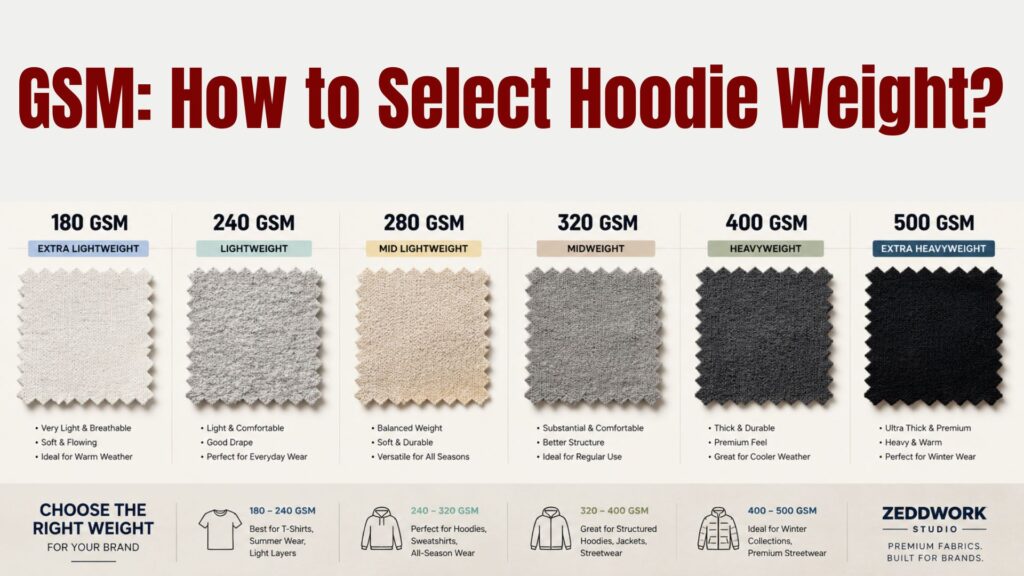
The practical breakdown works like this: lightweight hoodies fall in the 200–280 GSM range, midweight runs from 280–350 GSM, and heavyweight starts at 350 GSM and climbs from there. Each category behaves differently on the body, in production, and in the market.
What many brand owners miss is that GSM isn’t just a technical spec — it’s a positioning tool. Brands that build genuinely heavyweight garments list the GSM because it’s a selling point. When it’s hidden, the fabric is often lightweight.
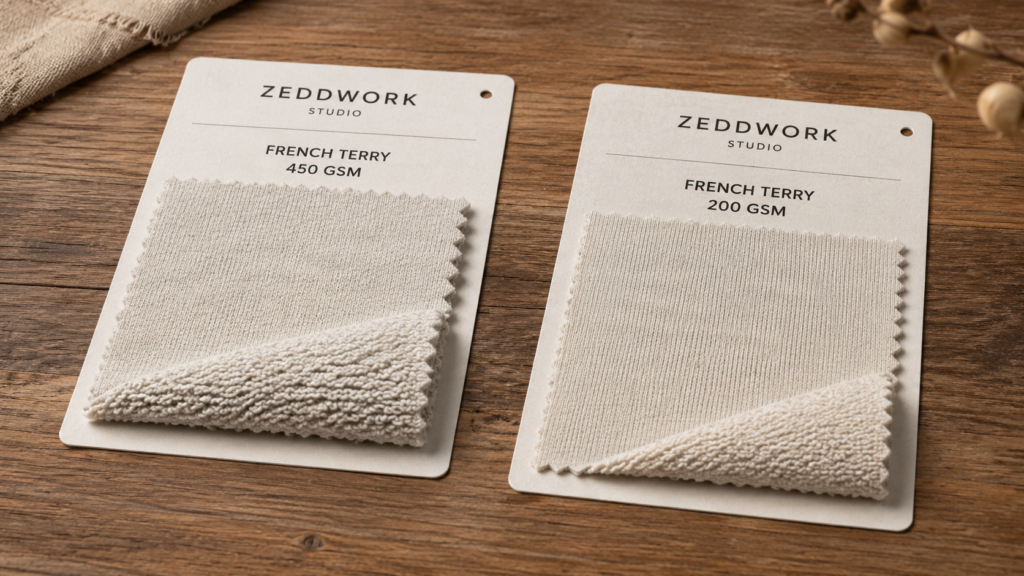
Lightweight hoodies are typically made from cotton-polyester blends, French terry cotton, single jersey cotton, and lightweight brushed fleece, usually in the 200–300 GSM range. These fabrics are engineered for breathability, softness, and flexibility, making them ideal for movement-driven lifestyles.
Understand the difference between French Terry and Fleece fabric here.
For brands operating in athletic, outdoor, or warm-climate markets, this is the natural fit. Lightweight hoodies in the 200–250 GSM range are perfect for running or gym sessions, while midweight options around 250–280 GSM work well for outdoor sports in cool weather.
There’s also a strong commercial case for lighter constructions for year-round inventory. Lightweight hoodies with lower GSM are ideal for warmer regions, which expands your sellable window across more markets and more months. If you’re sourcing for a global customer base or building an activewear-adjacent line, a 220–260 GSM hoodie keeps you from sitting on unsold winter inventory.
Lightweight doesn’t mean cheap, and this is an important distinction. In technical performance wear, a 240 GSM hoodie with moisture-wicking properties and engineered stretch is a premium product in its own right. The issue arises when lightweight fabrics are used at premium price points without the technical features to justify them, which brings us to perception.
Heavyweight Hoodies: What They Signal
Heavyweight hoodies, usually starting from 350 GSM and going beyond 600 GSM, are built using dense and structured fabrics such as heavy brushed fleece, compact cotton fleece, 3-end loopback fleece, and heavyweight French terry with high-density yarns. These fabrics create a firm, substantial feel that immediately changes how the product is perceived. It feels more expensive, more stable, and more intentional from the moment a customer touches it.
This is the category that dominates premium streetwear right now, and for good reason. At 400 GSM, specific mechanical behaviors emerge. Cotton yarns packed that densely resist wind on their own. The hood stands up behind the neck instead of collapsing flat against the shoulders. That structural quality is something customers notice immediately, even if they couldn’t name the GSM.
High-GSM fabrics at 350 GSM and above possess an innate “skeletal” quality, resisting fatigue and deformation from repeated wear. This is why limited-edition collaborative hoodies maintain their structured silhouette for years, while fast-fashion pieces lose shape after a single wash.
For brands competing in the premium or streetwear segment, this durability isn’t just a quality argument — it’s a loyalty argument. A customer who gets two years out of a heavyweight hoodie becomes a repeat buyer. A customer who watches a lightweight hoodie pill and stretch within six months doesn’t come back.
But the most common problem when working in heavyweight fabrics for hoodies, sweatshirts, and pullovers is that they are not feasible for most factories and manufacturers and thus not an easy material to source for brands, especially at lower quantities. At Zeddwork Studio, we work with custom GSM fabric development; we too have a minimum order quantity requirement, but it’s much lower than what most premium factories around the world have, with the same premium finish quality, if not better.
The GSM Decision Is Actually a Brand Positioning Decision
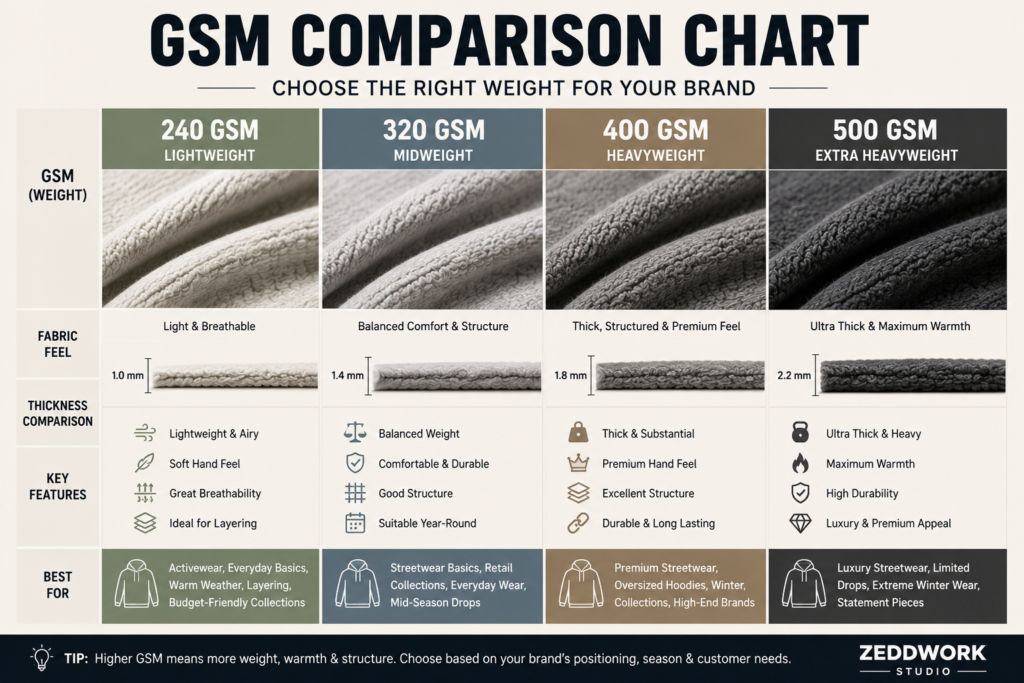
Here’s the honest framing: choosing your hoodie’s GSM is choosing who your customer is and what they’re willing to pay.
The decision between heavyweight and lightweight fabric weight ultimately depends on your brand’s positioning. Choose heavyweight if you’re targeting the premium streetwear market and your customers expect heft and structure. Choose lightweight if your customers are buying for activity, layering, or warm-weather wear — or if you’re building a higher-volume, accessible price-point line where margin management matters as much as perceived luxury.
For most mainstream streetwear releases, 320–400 GSM offers an ideal balance of comfort, drape, and customizability. For luxury, oversized, or statement pieces, 400–500 GSM is now the go-to. Brands at the ultra-premium end — limited drops, collaborations, capsule collections — are increasingly working in the 500–600 GSM range to create a product that genuinely cannot be confused with mass retail.
What you want to avoid is a mismatch between your price point and your GSM. If you’re charging premium prices for a 240 GSM hoodie with no technical story behind it, customers will feel it the moment they open the box — and they’ll remember.
How Fabric Weight Affects Your Print and Embellishment Options
This is a practical consideration that often gets overlooked until sampling, which is the most expensive time to discover it.
Heavyweight fabrics are essential for high-stitch-count embroidery. If you try to embroider a large crest on a lightweight fabric, the material will pucker and pull. Similarly, a heavyweight hoodie at 400 GSM can handle complex heat-transfer patterns that would cause a lighter hoodie to buckle under the weight.
If bold graphics, puff prints, or premium embroidery are central to your brand identity, your fabric weight needs to support that ambition. A lightweight construction will undermine the decoration quality regardless of how well it’s applied.
What Heavyweight Hoodies Cost You — and What They Earn Back
More fabric weight means higher material cost per unit, higher shipping weight, and typically more demanding construction requirements. This is real, and it needs to be in your margin calculations from day one.
Ultra-heavyweight options at 550–600 GSM are rarely available off-the-shelf and require advanced technical support and sourcing. While cost per unit rises significantly, the result is a hoodie with unmatched silhouette, durability, and market distinctiveness. In Zeddwork Studio, we can manufacture about any GSM of fabric as per your requirements.
The counterargument to the higher unit cost is resale perception and return rate. Generally, higher GSM hoodies tend to be more durable due to their thicker, denser fabric, which resists wear and tear better. Heavier fabric resists thinning, pilling, and losing shape, so a well-made heavyweight hoodie typically outlasts a lightweight one by years. Fewer returns, stronger word-of-mouth, and a customer base that attaches real value to the product — these are the commercial returns that don’t show up on a per-unit cost sheet but define long-term brand health.
A Practical GSM Guide for Brand Owners
If you’re deciding where to start, here’s a straightforward framework based on your product category:
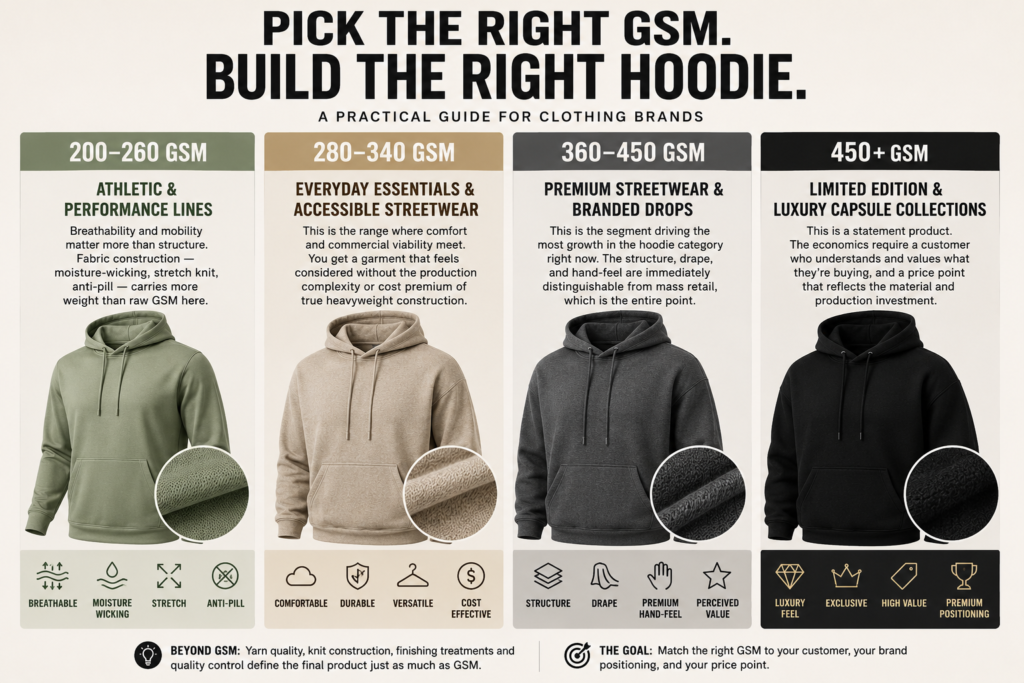
Athletic and performance lines: 200–260 GSM. Breathability and mobility matter more than structure. Fabric construction — moisture-wicking, stretch knit, anti-pill — carries more weight than raw GSM here.
Everyday essentials and accessible streetwear: 280–340 GSM. This is the range where comfort and commercial viability meet. You get a garment that feels considered without the production complexity or cost premium of true heavyweight construction.
Premium streetwear and branded drops: 360–450 GSM. This is the segment driving the most growth in the hoodie category right now. The structure, drape, and hand-feel are immediately distinguishable from mass retail, which is the entire point.
Limited edition and luxury capsule collections: 450 GSM and above. This is a statement product. The economics require a customer who understands and values what they’re buying, and a price point that reflects the material and production investment.
The Real Answer: It Depends on Your Brand, Not the Market Trend
The streetwear market has pushed heavyweight hoodies to cultural prominence, but that doesn’t mean a 500 GSM construction is right for every brand. Understanding the comparison between lightweight and heavyweight hoodies is a crucial factor for brands trying to build a strong identity, pricing power, and repeat customers in a highly competitive market.
The brands that make this decision well aren’t chasing what’s popular — they’re matching their fabric spec to their customer promise. A performance activewear brand that launches a heavyweight drop just because heavyweight is trending is misreading what their customer came to them for. A premium streetwear label that cuts corners on GSM to protect margin is eroding the exact thing their customer is paying for.
Know your customer. Know your price point. Know your production partner’s capabilities. Then pick the GSM that serves all three — and commit to it consistently across your collection.
Source Your Hoodies Right, From the Start
Getting the GSM decision right is only half the equation. The other half is finding a manufacturing partner who can actually execute it at your required quality level, at scale, and on time.
Zeddwork Studio works with brand owners at every stage of apparel development — from fabric selection and GSM strategy to sampling, production oversight, and export from India. Whether you’re launching a lightweight performance line or building a heavyweight streetwear drop, we help you match the right construction to the right factory, so you’re not learning the hard way on your first run.