The collections are in. The direction is clear. And for founders building menswear brands right now, the spring/summer 2026–2027 season carries a message worth taking seriously: the era of spectacle is over, and the era of considered product has begun.
From Milan to Paris to Florence, the industry’s most respected houses — Dior, Armani, Dries Van Noten, Dolce & Gabbana, Loewe, and Zegna among them — have converged on a shared position.
Wearability is the new luxury.
Fabric intelligence is the new flex.
And the brands that will build lasting equity in this market are the ones who understand that a well-constructed hoodie, a precisely fitted T-shirt, or a pullover made from an exceptional yarn says more about a brand’s values than any campaign ever could.
This is a guide for founders who are building in that space — or who want to be.
The Market Context: Why SS26–27 Is a Pivotal Season for Menswear Brands
Before examining individual product and trend directions, it’s worth understanding the commercial environment that’s shaping them.
Consumer spending patterns in menswear have shifted materially. According to McKinsey & Company’s State of Fashion 2025 report, premium and luxury menswear is one of the few apparel segments continuing to grow in volume terms, while the mid-market is under sustained pressure from both value alternatives and premium trade-up behaviour.
The implication for founders is significant: the consumer is not disappearing, but they are polarising. They are either buying cheap or buying better — and the brands winning in the better tier are the ones with a defensible product story rooted in quality.
The Business of Fashion’s trend analysis for SS26–27 echoes this, noting that menswear’s most commercially durable direction is toward “quiet confidence” — pieces that carry authority through construction and material rather than logo or statement.
This is the season where the basics programme becomes the brand’s most important commercial asset.
Understanding what that means across the key product categories is where strategy starts.
Top Menswear Trends SS26–2027
1. Lightweight Tailoring Fabrics for Heat-Conscious Menswear
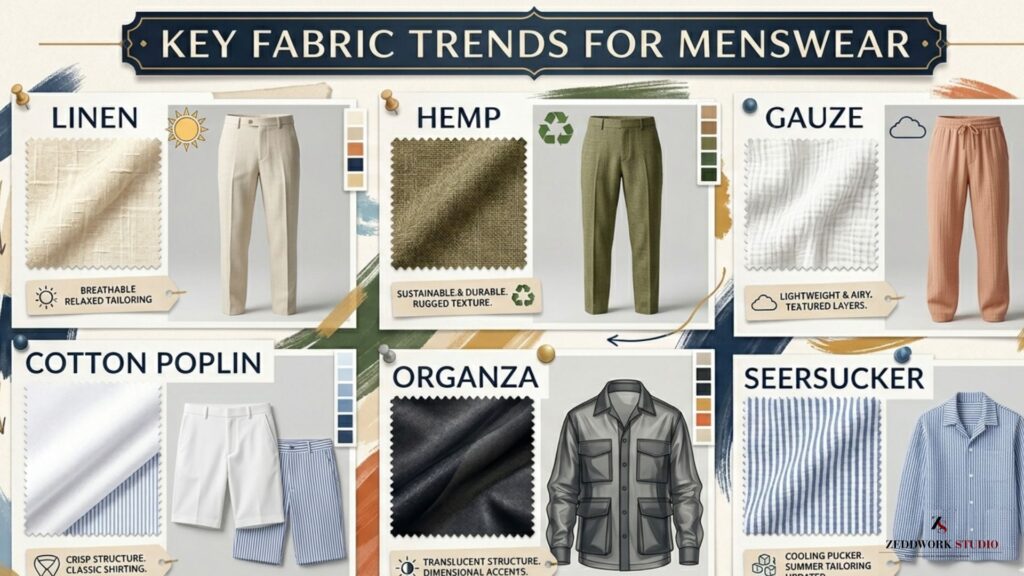
Climate is no longer a contextual backdrop for menswear — it is a design driver. The SS26–27 collections have made this explicit, with destructured, unlined jackets built for heat, fluid trousers that move with the body, and overshirts that function as a single-layer solution across temperatures.
The fabrics driving this shift are ones with genuine technical credentials: linen in refined weights, 100% cotton, cotton modal blends, gauze, cotton poplin, organza for layering, and seersucker — a textile that has staged one of the season’s most significant comebacks, cited across both Italian and French collections for its natural heat management properties.
For brand founders, the lesson here is less about chasing runway looks and more about understanding fabric performance as a product story. A linen overshirt isn’t a trend play — it’s a functional proposition that a customer can understand and justify. Transparency about fabric provenance and performance is becoming a purchasing driver in the premium menswear segment, particularly among the European and North American consumers who represent the highest-value cohort.
Reference: Textile Exchange’s 2024 Preferred Fiber & Materials Market Report documents growing consumer willingness to pay a premium for natural, traceable fibres — with linen and hemp among the fastest-growing categories. Read the document here.
2. Elevated Casualwear: Building the Luxury Casual Programme
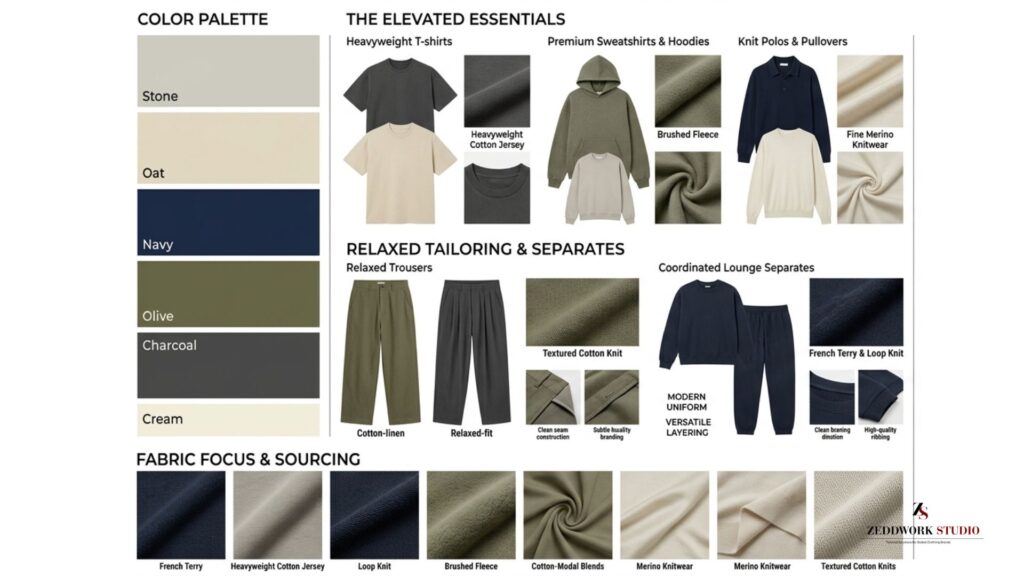
One of the defining commercial opportunities of Spring Summer 2026–2027 is the continued blurring of the line between loungewear and luxury. The runway gave us pyjama sets styled as eveningwear, shawl-collar jackets worn over fluid trousers, embroidered silk overshirts, and kimono-influenced outerwear — all at Dior, Armani, and Dries Van Noten, among others.
What this represents for brand founders is not a directive to make pyjamas. It is a signal that the elevated casual wardrobe — from T-shirts and hoodies to pullovers — is being designed to meet a new need: a garment that a man reaches for when he wants to feel dressed without effort.
The product implications are concrete. Instead of regular basic hoodies, create embroidered or artisan-detailed basics that justify a higher price point through craft rather than branding.
This is a category where quality of execution — the weight of the fabric, fabric qualities like supima cotton, the precision of the embroidery, the drape of the silhouette — determines whether the product reads as premium or merely aspirational.
Reference: WGSN’s SS26 Menswear Macro Trends report identifies “Palazzo Dressing” as one of the four core directional narratives for the season, driven by consumer demand for versatile luxury pieces that transition across contexts. Read the report here.
3. Stripe Constructions and Print Programmes That Command Retail Space
Stripes are the print story of SS26–27. Across collections, they appeared in every iteration — sailor and nautical stripes, tennis club styling, pyjama-weight vertical stripes, and fine pinstripes applied to suiting and separates. Designers as diverse as Thom Browne, Paul Smith, and Etro built significant portions of their SS26–27 narratives around the motif, exploring the tension between discipline and irreverence that stripes have historically represented in menswear.
For brand founders, menswear designers developing a print or fabric programme, stripes offer a commercially reliable entry point with significant differentiation potential. The key variables are execution quality and application — the weight of the fabric, the precision of the weave or print registration, and whether the stripe is deployed in expected or unexpected product contexts.
A well-executed stripe in a premium weight seersucker or a fine-count poplin will retail very differently from a commodity-printed equivalent, even if the visual reads as similar at first glance.
Reference: Première Vision’s SS2026 Fabric and Print Trend Report cited stripe constructions as one of the top five repeat patterns for the season, with growth concentrated in woven rather than printed executions.
4. Bottomwear: Shorts, Joggers and Chinos
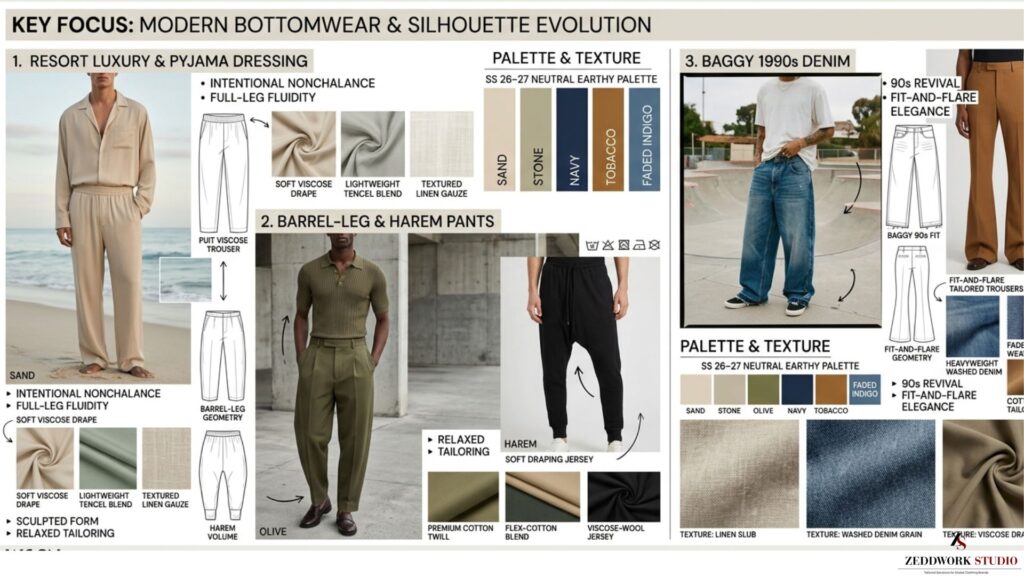
The dominant direction is volume — but volume with intention. SS26–27 bottomwear moves away from the sculpted, body-close fits of recent seasons toward shapes that feel liberated without looking careless.
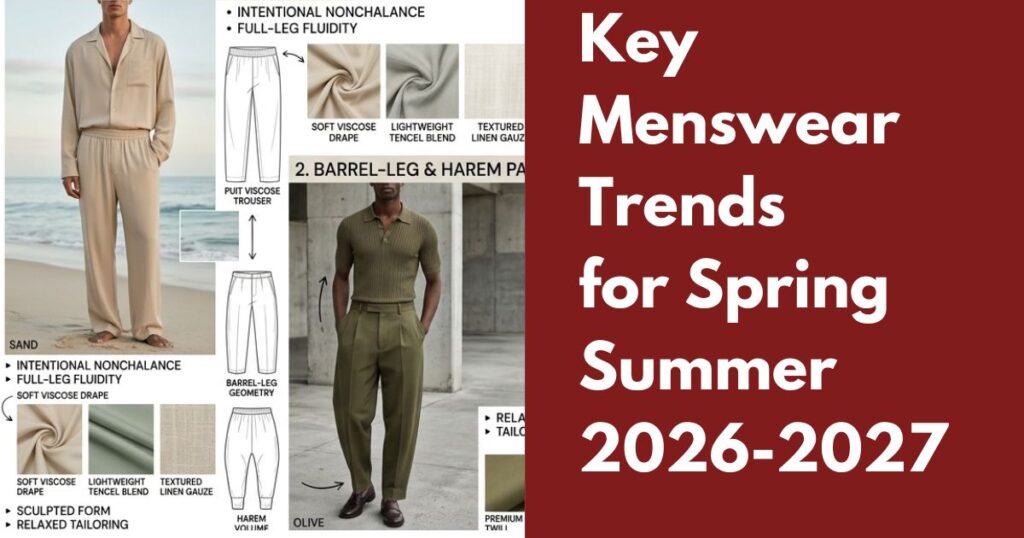
Fluid Trousers are the season’s quietest power move. Loose, lightweight, and borrowed from pyjama and resort dressing, they are being worn on the street with sandals and minimal styling — proof that ease has fully arrived as a luxury signal rather than an abdication of it.
Barrel and Harem Legs push the silhouette further. Where wide-leg was the last cycle’s answer to slim, barrel and harem cuts are this season’s evolution — voluminous through the thigh, tapered at the ankle, and genuinely fresh on the floor after years of the same trouser options.
Baggy Denim is no longer a subcultural reference — it is a mainstream menswear staple. The 1990s silhouette, worn low with a deliberately visible waistband, has completed its journey from streetwear archive to retail best-seller.
Fit and Flare brings a more tailored hand to the volume conversation — structured at the waist, opening through the leg, and offering a shape that photographs well and wears even better in motion.
The SS26–27 Colour Programme: Brights, Pastels and How to Build a Cohesive Palette
The colour story for menswear spring/summer 2026–27 operates on two distinct frequencies, and the most commercially sophisticated brands will find a way to speak both languages within a single coherent collection.
The first is explosive and chromatic — gold, electric turquoise, meadow green, red, and electric blue. These are the statement pieces and hero SKUs that generate attention, earn editorial coverage, and signal that a brand has a confident point of view on the season.
The second is the palette where the volume sells: sage, warm sand, baby blue, blush pink, and off-white. These are the repeat-purchase colours, the basics that a returning customer reaches for, and the foundation of a scalable casualwear programme.
The critical executional challenge — and the one that separates a premium colour programme from a commodity one — is consistency. Colour accuracy across a range, batch-to-batch consistency in production, and the stability of the dye after repeated washing are not aesthetic decisions. They are quality and commercial decisions. A sage hoodie that arrives from the second production run in a different shade is a customer service problem, a return driver, and a brand trust issue.
Reference: Pantone’s Fashion Color Trend Report Spring Summer 2026 identified “Grounded Naturals” and “Charged Chromes” as the two co-existing macro directions in menswear colour — aligning with the bifurcated palette narrative across collections.
Creative Direction: Layering, Proportion and the Styling Intelligence Your Brand Needs
The most technically interesting styling direction of SS26–27 is in the layering and proportion experiments that appeared across collections — boxer waistbands intentionally exposed above trouser waistbands, multiple trouser layers as a silhouette statement, trompe l’oeil constructions that create the visual of layering within a single garment.
These are not mass-market product directions. They are creative intelligence — signals about where menswear’s relationship with the body and with dressing conventions is heading. For brand founders, the value is less in replicating the specific looks and more in understanding the underlying logic: that menswear consumers are increasingly comfortable with ambiguity, with play, and with clothes that ask something of them stylistically.
That comfort is an invitation for brands with a genuine point of view to take more creative risk in their product programme — knowing that the market is ready for it.
Why India Is the Manufacturing Foundation for Global Menswear Spring Summer 2026–2027
The fabric and construction requirements of menswear spring/summer 2026–27 align precisely with what India’s textile ecosystem does at its best.
Linen, cotton, and in woven fabrics and cotton modal, supima elastane for jersey fabrics such as singe jersey, french terry, fleece in premium weights. Artisan embroidery and weaving traditions with direct applications to the season’s elevated casual narrative. Fine-gauge knitwear facilities built to European quality standards. And a manufacturing infrastructure that has invested significantly in digital sampling, sustainable dyeing, and scalable production systems over the past decade.
The comparative advantage is real and documented. India is now the second-largest textile exporter globally, with particular strength in the natural fibre and artisan craft categories that define SS26–27’s most commercially durable directions. For brands sourcing or considering India as a manufacturing base, the question is no longer whether the quality is there — it is whether their manufacturing partner has the systems to deliver it consistently.
Building Your SS26–27 Menswear Collection: The Strategic Framework
The founders who will build the most durable menswear businesses from this season will be the ones who approach SS26–27 with a clear strategic framework rather than a trend shopping list.
The questions worth answering before product development begins:
What is our hero product, and does it have a defensible quality story?
In SS26–27, the hero product for most premium menswear brands should be in the elevated basics territory — a hoodie, a T-shirt, a pullover, or an overshirt built from an exceptional fabric with a construction that can be explained and verified. This is where customer loyalty is built and where word-of-mouth is generated.
What is our colour and fabric programme, and can we deliver it consistently?
A collection built around the SS26–27 palette only works if the colour delivery is precise and consistent across production runs. This is a manufacturing question as much as a creative one.
What is the narrative that connects our product choices?
The most commercially successful collections of SS26–27 will be the ones with a coherent story — a resort life narrative, a sport heritage capsule, a fabric-first elevated basics programme — that gives buyers and consumers a reason to invest in the collection rather than cherry-pick individual pieces.
Who is our manufacturing partner, and do they have the quality systems to deliver what we’re promising?
Premium product requires premium manufacturing. The gap between a well-designed product and a well-executed one is entirely determined by the quality of the production relationship.
How Zeddwork Studio Supports Menswear Brands for SS26–27
Zeddwork Studio is an India-based premium manufacturing partner working with menswear clothing brands in Europe, the UK, and the United States. Our focus is on elevated basics — hoodies, T-shirts, pullovers, overshirts, and casual separates — built from premium Indian-sourced fabrics and manufactured to the quality standards that global retail buyers and direct-to-consumer brands require.
Our programme for Spring Summer 2026–2027 includes:
Fabric sourcing and development — Direct mill relationships across linen, hemp, cotton, organic, and blended fabrications. Certified options available for brands with sustainability commitments.
Sample development and fit architecture — In-house pattern-making with structured fit rounds and wash testing built into the standard workflow. We do not move to bulk without a sample that meets your specification.
Construction and finishing quality — From collar construction and seam finishing to ribbing tension and wash processes, the details that determine perceived quality are managed at every stage of production.
Colour programme management — Eco-responsible dyeing with colour consistency across bulk runs. We provide spectrophotometer-verified colour approval before production begins.
Quality assurance — Pre-production, inline, and final inspection processes with documentation aligned to the requirements of premium European and US retailers.
Production scalability — From capsule launch runs to full seasonal programmes. Our infrastructure scales with your brand’s commercial trajectory.
If you’re a menswear founder building a collection for SS26–27 and looking for a manufacturing partner who takes product quality as seriously as you do, we’d like to have a conversation.